Showing posts with label conservation. Show all posts

Tuesday, October 23, 2012

Happy 40th Birthday National Marine Sanctuaries Act!


True or False? The oceans are vast and inexhaustible in resources.  While not too long ago scientists believed this to be true, it is resoundingly false.  While the oceans are vast, the resources they provide the planet must be managed effectively to ensure a healthy planet and healthy people.  No matter where we live, whether it is on the coast or hundreds of miles inland, the ocean affects our everyday life.  The ocean provides much of the oxygen for planet Earth through the photosynthesis of phytoplankton, algae, and other aquatic plants;  the ocean regulates the planet’s weather and climate; we rely on the ocean for transportation of goods; the ocean provides us with food; the ocean floor provides us with natural resources including oil and natural gas; the ocean provides other resources that are used in medicine.  If the ocean is not healthy, we are not healthy.

Over the last two centuries, the human population has exploded and technology has advanced at breakneck speed.  This made areas once remote and inaccessible to people within reach.  Coastal development contributed to pollution of estuaries and near shore areas.  The need for food caused a gold rush of sorts to the coast where fishers exhausted fisheries to the point of collapse.  Something needed to change, and proactive measures needed to be taken to ensure that our ocean resources could endure for generations.

1972 was a good year for environmental legislation.  The Clean Water Act (CWA) and the Marine Mammal Protection Act (MMPA) are two well known pieces of legislation that passed into law in 1972.  They were landmarks for conservation, giving agencies the obligation to regulate clean water and punish individuals or organizations that harm marine mammals, many of which are threatened or endangered.  However, another act was also passed that same year.  It is just as important as the CWA or MMPA.  It addresses some of the challenges described above and the goal of this act is to ensure that future generations can enjoy the cultural, economic, and ecological benefits of the marine environment:  The National Marine Sanctuaries Act (NMSA).


The NMSA gives authority to the Secretary of Commerce to designate areas of the marine environment as national marine sanctuaries.  These areas may be selected based on conservation needs, economic or ecological benefits they provide, or their cultural archaeological or educational qualities they possess.  Currently, there are 14 National Marine Sanctuaries in U.S. waters, and each protects a precious resource for us and for future generations.  Sanctuaries may protect a significant archaeological site from degradation, nursery areas for commercially important fish, breeding grounds for fish and marine mammals, or may have a high diversity of organisms in that area.

Currently the NMSA is under reauthorization.  This means that the Act may be updated so that it can adapt to current management regimes for marine resources,  In addition, it may also allow for more sanctuaries to be added to the national system.  More sanctuaries means more areas where fish and other marine animals can escape from intense pressures from people.  More marine sanctuaries means healthier oceans:  future harvest for fishers, scenic places for divers and snorkelers to enjoy, and refuges for marine animals.  


Friday, September 28, 2012

Where is your Watershed?


Freshwater is the most precious resource on our planet.  Though approximately 75% of the Earth is covered in water, only 3% of that is freshwater.  Less than 1% of that is accessible to humans; the rest is either frozen, underground, or otherwise out or reach.  When you think about it, that’s not much water to share between 7 billion people and all the animals that call our rivers, streams, and lakes home.  In order to ensure there is enough clean water to go around, we need to be good stewards of our watershed.


What is a watershed?  It is an area of land where all the water within it drains to the same place.  Watersheds can vary in size, and there can be watersheds within watersheds.  For example, a drop of water from a rainstorm may hit the ground in the watershed of a smaller river, like the Conasauga.  That water in the Conasauga watershed runs into the Coosa River, making it part of the Coosa Watershed. The Coosa then flows into the Alabama River, which ultimately flows into Mobile Bay.  These watersheds are all connected, and how we take care of our watershed not only directly affects us, but also impacts our neighbors downstream. 


There are many impaired watersheds in the United States, including the Southeast.  Mobile Bay,  one of the largest watersheds in the U.S., has some rivers that run through highly urban, industrial, and agricultural areas.  Therefore, pollution is a big problem in the form of fertilizers, chemicals, and sediment.  In Chattanooga, Citico Creek is highly polluted because damaged septic tanks and sewer lines discharge their effluent into the creek.  That pollution flows into the Tennessee River, where Chattanoogans get their drinking water.  While our local water company does a very good job ensuring that water is safe for us to drink, the pollution stays in the river and affects the fish, mussels, other animals, and even recreational users who call the Tennessee River home.  

What is your watershed?
 
What can you do to protect your watershed?
  •  Find your local watershed group and volunteer.  Once you have found which watershed is yours, the EPA provides a list of groups that work to protect that watershed. 
  •  Adopt your watershed. If your watershed doesn’t already have a citizen-based group, you can use EPA’s Watershed Stewardship Toolkit to start one.
  •  Practice responsible water consumption.  Decreasing the amount of water you use each day ensures there is more in the watershed for plants and animals, and will lower your water bill. 
  •  Be as organic as possible with your lawn, reducing fertilizer and pesticide use.
  • Find your nearest Waterkeeper. These people devote their time to making sure their river is free from pollution or other harmful activities.  Support them with your time or money so they can make sure you have a safe river to use.  
If you are in Chattanooga, October 6th is the next Tennessee River Rescue. Find your nearest zone and spend some time cleaning the Tennessee River. It’s our river, so let’s make sure it is safe for all the people, plants, and animals that rely on it. We hope to see you there!
 

Tuesday, September 11, 2012

Snorkeling with Alexandra Cousteau


In 2009 the Tennessee Aquarium was awarded a grant from the National Oceanic and Atmospheric Administration to increase inland residents’ awareness of their connection to the ocean.  One part of this ambitious project is the “Our Blue Planet” lecture series that has brought leaders in ocean research and conservation to the Tennessee Aquarium.  Last week, the last speaker of the series is part of a family whose name is synonymous with ocean exploration: Alexandra Cousteau.

Like her grandfather, Alexandra is a passionate environmentalist.  She is an advocate for sustainable management of our water resources.  She has traveled the globe to locations where watersheds have been negatively impacted by water misuse, but also to places where sustainable management of water has been successful.  Her mission is to "engage individuals around the world through telling the story of our water planet."

She accomplished this mission as she spoke to high school students in the morning, then to a full house in our IMAX theater that evening.  She showed some of the short documentaries she has filmed all over the world, but focused on some of the imperiled watersheds in North America, including the Emory River, the Colorado River, the Potomac River, and Mobile Bay.  These videos, as well as her no-nonsense presentation style, were successful at motivating citizens of all age groups.  She encouraged all of us to be conscious of our water use, and to be advocates for our watersheds.  Everyone has the right to clean water.

We decided to take Alexandra to the Hiwassee River and show her some of the aquatic wildlife that makes the Southeastern U.S. so unique.  We were joined by two Waterkeepers:  Donna Lisenby the Watauga Riverkeeper, and David Whiteside the Tennessee Riverkeeper.  We had a brief, but eventful, time on the Hiwassee. Our catches included three Hellbenders, a Tangerine Darter (Percina aurantiaca), and one of the most controversial fish in history, the Snail Darter (Percina tanasi).  It was a great day on the river and everyone had a good time. We hope Alexandra will come back.

Donna Lisenby and Alexandra Cousteau with a Hellbender

Tangerine Darter (Percina aurantiaca)


Snail Darter (Percina tanasi)
TNACI with a tanasi!

Anna and Alexandra with a Hellbender
All photos taken by Andree Herbert.

Here's a great video about the day from our friend, Donna Lisenby.

Tuesday, August 14, 2012

Conservation Leadership in Action Week


Guest Blogger:  Louise McCallie

What do you get when you have twenty high schoolers and a week of outdoor adventures, then add three days of unexpected, non-stop rain? Apparently those are the ingredients for the Tennessee Aquarium Conservation Institute's up-and-coming summer camp, Conservation Leadership in Action Week (CLAW). Led by Dr. Anna George and Ashford Rosenberg, the campers were exposed to a variety of local conservation issues, then were challenged to form their own plans for creating change.

I've been a summer camp counselor before, but never for high school kids. I wasn't exactly sure what to expect. But after CLAW 2012, I can say with full certainty that our kids were a fabulous first class. Our twenty campers were from fifteen different high schools, some coming from as far away as Memphis, Georgia, and Newport News, VA. It was an adventure waiting to happen, and the kids delivered.

CLAW 2012 was a residential camp, with our home base on Baylor School's campus, and once we got everyone registered and moved in, we kicked off the week with a trip to the Tennessee Aquarium. Several of our campers are youth volunteers at the Aquarium, but they too enjoyed the behind-the-scenes look at the exhibits, as well as the private tour. Our aquatic adventure ended in a sleepover in Ocean Journey's Undersea Caverns, where the campers snuggled into their sleeping bags while sandbar sharks and brightly-colored fish swam by overhead.

Monday's theme was "water," so we were up bright and early before heading over to Renaissance Park to discuss water quality testing. Our next destination was the Hiwassee River, where we took more water quality samples and met up with some more TNACI scientists to see what they'd caught in the crystal-clear waters. The highlight of the afternoon was an eighteen-inch long hellbender, which the kids stroked and posed with for pictures. We turned our campers loose on the river to see what else the riffles had in store - and several of them even hand-caught another hellbender! Talk about a victory lap.
Getting to touch the Hellbender
We then bid adieu to our fishy friends and shifted gears for our next activity:white-water rafting! It was a cool, foggy afternoon that certainly beat the 100-degree heat we'd been having, and we all made it down the river without too much trouble.
Lauren and Kevin on the duckie.
After rafting, we headed back to Baylor to discuss and create rain barrels, provided by Coca-Cola and Ace Hardware. We tied off our day with a talk from Dr. Richard Urban from the Tennessee Department of Environment and Conservation, where we learned about the legal aspect of water conservation. Definitely interesting for all our up-and-coming policy makers.

Whew! You'd think we'd be all out of things to do after Monday's busy schedule. But the fun had barely started! Tuesday was "Food Day," which we began with a trip to Crabtree Farms. Crabtree gave the campers a hands-on experience with local food, as they smeared themselves with dirt picking beets in the fields. They were pretty "beat" after that adventure, but our next stop was the Southside for a trip to Link 41 and Niedlov's. Then it was back to Baylor for a lesson in cheesemaking from TNACI's Kathlina Alford, who walked the kids through batches of mozzarella and feta. The highlight of "food day" was our evening meal - Executive Chef Charlie Loomis from Greenlife Grocery came to Baylor and prepared a variety of delicacies crafted from the local food we'd picked up during the day.
The whole group with our fine selection of beets
Wednesday was "Waste Treatment Day," and even though a large, literal raincloud had settled over Chattanooga, the campers were still energetic and ready to learn. Our morning consisted of a trip to Moccasin Bend Wastewater Treatment Facility, where we split into two groups to tour the plant and learn about the process of wastewater treatment. Though the campers were holding their noses and making faces over the smell, they later proclaimed that the trip to Moccasin Bend was one of the highlights of the week. Later that afternoon, we visited the Tennessee American Water Company (who awarded TNACI a $1,000 grant to help fund camp) for a tour of their facility and a brief discussion of the other side of water treatment. Wednesday evening, Nathan Moore from the Southern Environmental Law Center spoke to us about the importance of policy in conservation efforts.

Lily thinks it's stinky at Moccasin Bend

CLAW with our fabulous tour guide, Matt Snyder.

By Thursday, the rain had not let up, which quashed our plans of canoeing. However, the campers still had projects to work on: creating a program to bring back to their high schools and communities, inspired by the issues we'd touched on during the week. Thursday afternoon, we toured the RockTenn recycling facility. All geared up in hard hats and safety vests, the kids got a closer look at where our recycling goes after we put it out on the curb.


Justice in her hard hat ready to go!

Later that evening was "networking night." Dr. George invited a wide variety of community leaders, from Aquarium employees to professors, to listen to the presentations our campers had been working on. This event gave the students invaluable experience with public speaking and presenting, along with giving them the chance to further hone their projects. Many of the campers even swapped contact information with guests. I for one was glowing with pride, watching our campers have passionate, one-on-one conversations about their projects with complete strangers. It was a little different than the rapid pace of our other activities, but networking night was incredibly effective and will certainly be repeated in the future.


Groups talking to various experts about their projects.

Vega talking with a Sewanee professor.

Friday - our last full day - was another day out on the water, but this time we ventured up to the Conasauga River for a snorkeling expedition - wetsuits and all! Scientists from TNACI took some campers upriver for some more experience with seine netting, then showed off their catches in little clear photo tanks. After lunch we split into two groups again: one group of campers stayed by the river to continue snorkeling, while the others went on a bird walk through the surrounding wilderness.
Only way to see fish is getting your face in the water!

Looking for some birds

I think Thaddeus sees a fish!


Friday night was another big event - one of our campers was chosen to give her presentation at PechaKucha, a low-key style of presenting where the topics ranged from unsanctioned racing to nature poetry. Our student, Justice Graves, stood her ground in front of a crowd of more than a hundred and spoke passionately about the importance of preserving the environment. She even worked in some of our pictures from the week, discussing how our activities had inspired her and pushed her to think on a larger scale.

And then Saturday morning rolled around, when the parents arrived to see what we'd been doing with their kids all week. Our campers gave their presentations in groups of four or five, using KeyNote and some shared iPads to turn their ideas into something visual. The presentations passed in a flash, and before we knew it, we were waving goodbye and hauling our own gear down to our cars. I'm sure I wasn't the only one who slept well that night!

I was honored to be a part of such a successful inaugural experience. And a big thanks to Thaddeus Taylor, Larry Roberts, and Ben Nelson who were with us all week on our adventures.  The program has an incredibly solid base, and I'm thrilled to see how it will grow and change as the years go by. So here's to CLAW, and here's to many more years of adventure and discovery!

Thursday, May 31, 2012

Summer Conservation Tips


Summer is upon us and we all know what that means: time by the pool, kids home from school, and relaxing.  However, summer is also a time where conservation of resources is of utmost importance.  Don’t get me wrong, it is important to be a conservationist year-round, but certain pollution problems tend to be worse in the warmest months of the year.  So here are some tips to have some fun this summer, but feel good about the resources you are saving and the positive impact you are having on the environment.

1.  Carpool to work or other destinations.  Air quality is worse in the summer due to the warm temperatures.  One particularly hazardous air pollutant in the summer is ozone.  Ozone is important in the upper levels of the atmosphere, but in high concentrations in the lower atmosphere it can cause respiratory problems. Ozone enters the lower atmosphere when some pollutants from car emissions react with sunlight. 
2.   Wash your car on your lawn.  I know I mentioned this in a recent blog post but it’s an easy step to reducing runoff pollution. Now that spring is almost over, your car is covered in pollen.  And with summer fast approaching you want to keep your car free from bug splatter and bird droppings.  By washing your car on your lawn instead of your driveway, some of the grass and soil will prevent the dirt, grime, and soap from entering waterways.
3.  Go easy on the A.C.  Especially in the South, summers can be absolutely sweltering, and it’s tempting to turn the air conditioning way down to stay cool.  If you are in the South, the electricity for your air conditioning may be supplied by coal burning power plants.  The burning of coal sends harmful pollutants into the atmosphere and can cause other environmental problems.  The methods by which companies obtain coal are also very damaging to the environment.  While evenings are still in the low 70s, try turning off the AC at night and opening some windows.  Once it gets too warm to do that, keep the thermostat set to about 75-78 degrees.  It may seem too warm, but it will still be about 15 degrees cooler than the outside temperature.  You will also be saving money on your electric bill, and who doesn’t want to do that!?
4.  Use a rain barrel for your garden.  If you are a home gardener, try using a rain barrel to water your plants.  It’s another money saver that’s also a good conservation action.  You won’t have to pay for the water coming out of the hose. 
5.  Water your lawn at cooler times of the day.  During hot summer months, the warm temperatures increase evaporation.  To minimize evaporation and ensure you use water on your lawn more efficiently, water your lawn early in the morning or late in the evening.  

Thursday, May 24, 2012

Start of Sturgeon Season 2012!

Well it’s that time of year again!  On May 23 Kathlina took our team of new interns down to Warm Spring National Fish Hatchery to pick up our baby sturgeon for the year, a little over 2,000 fish!  These are juvenile Lake Sturgeon (Acipenser fulvescens), a very special fish that used to be abundant in the Tennessee River.  However, due to overfishing and habitat degradation they became extirpated from Tennessee in the 1960’s.  With recent water quality improvements, TNACI has been part of a long term program dedicated to returning this fish to Tennessee waters. 


Kathlina and Carlos at Warm Springs National Fish Hatchery

Kathlina and two of our husbandry interns, Jessica and Stephen

These babies are tiny now, approximately 2-3cm (0.8-1.2 inches).  But the fish can grow to be 8 ft long and around 300 pounds!  They are also incredibly long-lived, the oldest on record being 154 years old. Your grandchildren may encounter these baby fish in the future!  Since the start of this project, around 100,000 Lake Sturgeon have been released into the Tennessee River.


The fish that we picked up today will be housed at our husbandry warehouse until they are approximately 6 months old.  In the fall we will release them into the Tennessee or Cumberland River.  Stay tuned over the summer to hear updates on our sturgeon nursery!

Thursday, April 19, 2012

Field Notes: Week 2 on the Conasauga River


After a week of some cooler weather, TNACI and CFI returned to the Conasauga River for two more days of field work.  We spent the first day catching more Conasauga Logperch and the second day  releasing juveniles at various locations in the Conasauga River. 

On April 12 we worked a 3 mile stretch upstream of the site sampled on April 5.  While the procedures for this week were the same as last week, the conditions were very different.  The water temperature was 50°F when we arrived in the morning; cold enough that some members of the team wore dry suits.  The rest of us wore 7 mm wet suits and everyone wore gloves and hoods to stay as warm as possible.
Dr. Anna George in a dry suit.
Despite the chilly conditions, it was another successful day on the river.  We were able to get nine more fin clips from Percina jenkinsi.  We also caught a few Mobile Logperch (P. kathae) who were also photographed and fin clipped.

Photographing and fin clipping Logperch
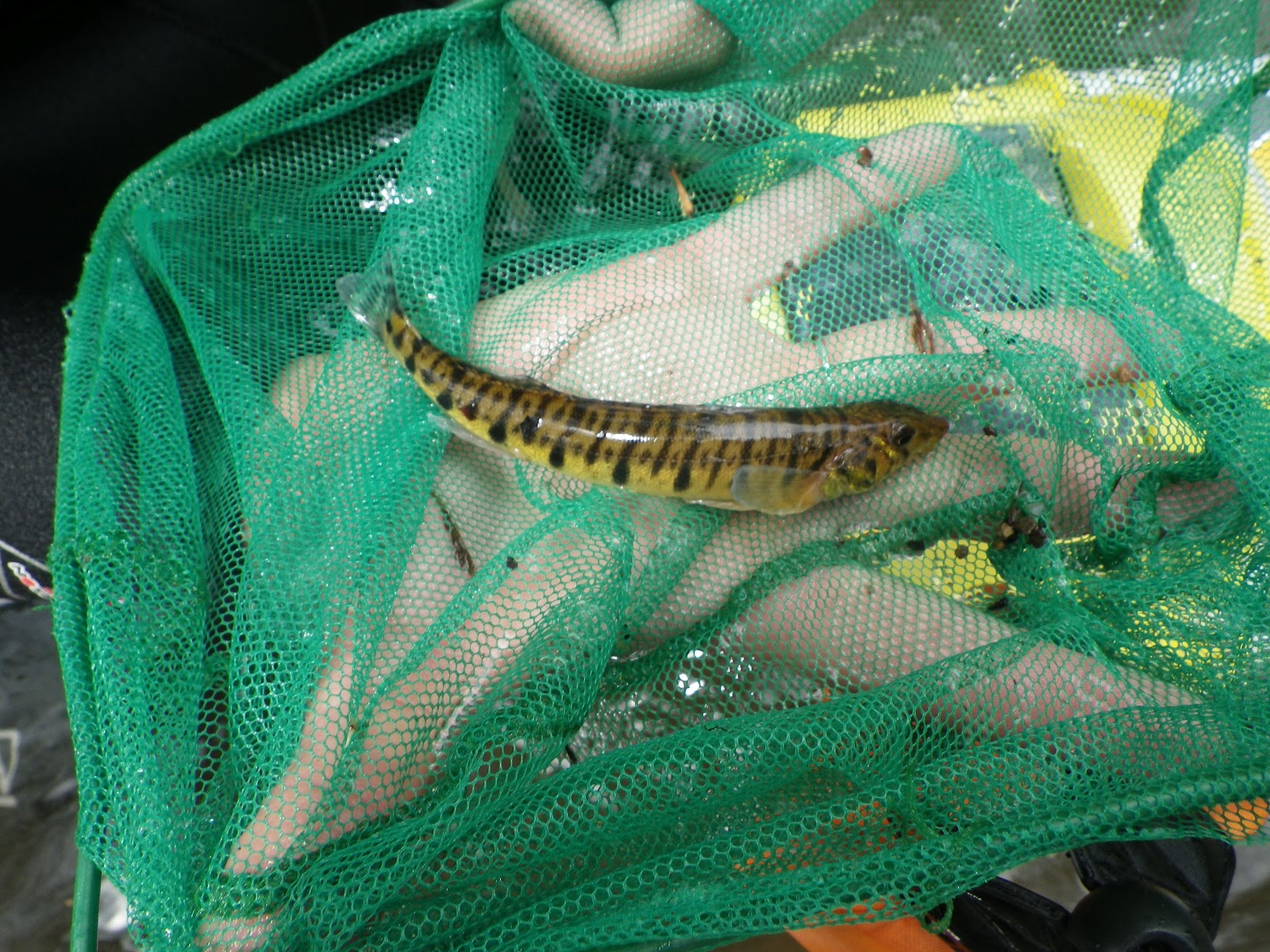
In the field it can sometimes be challenging to distinguish between Conasauga Logperch and Mobile Logperch initially.  However, upon closer observation there are some differences in the two species that make them distinguishable from one another.  One of the most distinguishing features is the red or orange color in the first dorsal fin of the Mobile Logperch.  The markings on the two species are different as well.  While both have bars, or “dorsal saddles,” down their body, the markings on the Mobile Logperch are a bit duller.  Conasauga Logperch have more defined stripes, a "teardrop" marking under the eye, and no color on the dorsal fin.  

Conasauga Logperch (Percina jenkinsi)
Mobile Logperch (Percina kathae)


While we were on the hunt for the very special Conasauga Logperch we were fortunate enough to see a few more aquatic animals that call the Conasauga home.

Coosa Darter
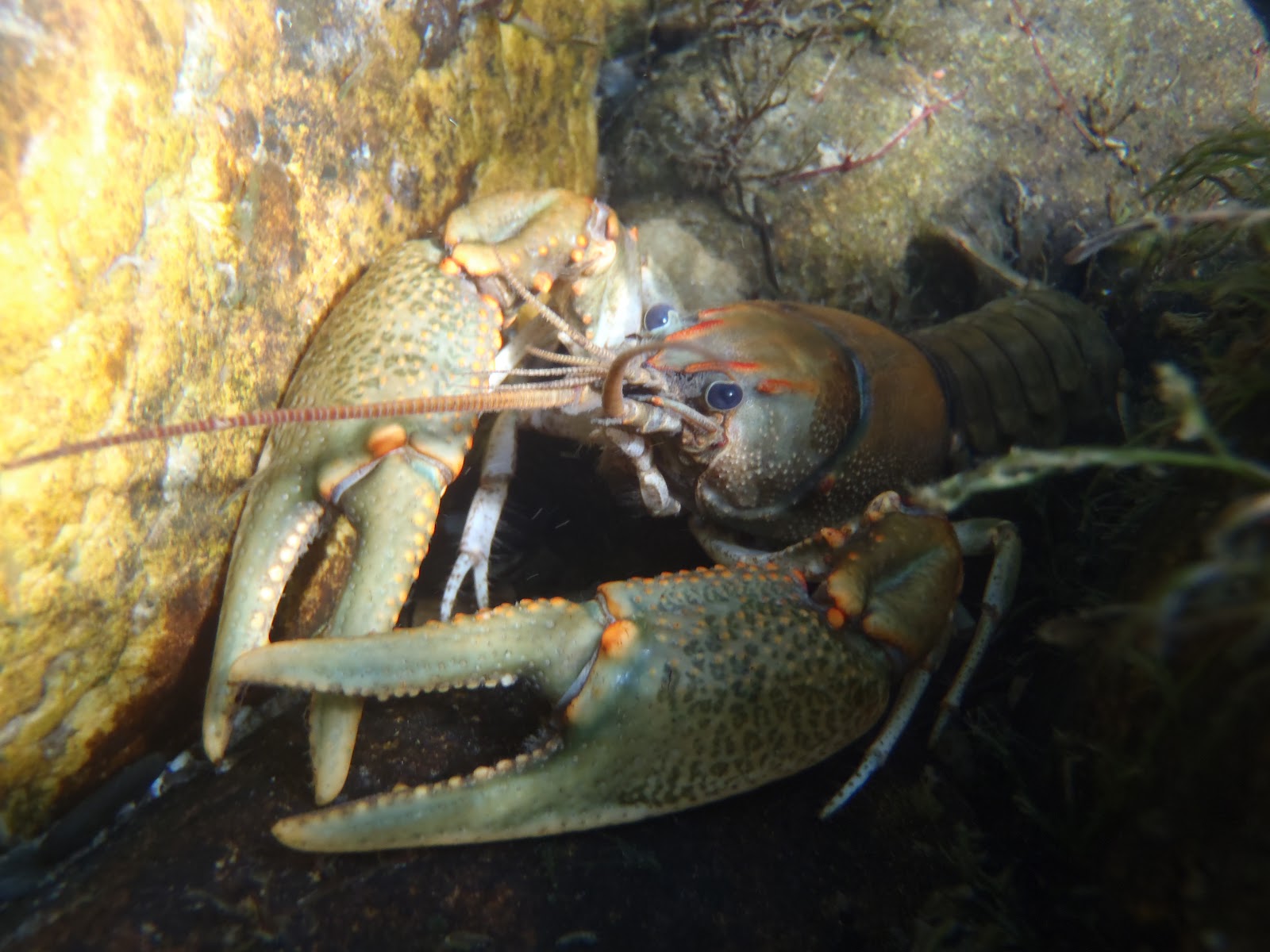
Crayfish
Hogsucker with a Lamprey attached


Speckled Darter
On April 13 we returned to release juvenile Conasauga logperch that had been hatched at CFI and reared either at their facilities or at TNACI.  We split up into two groups to cover almost 7 miles of river and release around 200 fish!

Releasing captive-bred fish into the wild is much more complicated than just dumping a bag full of fish into a river.  It takes scientific study and planning. During the previous two trips on the Conasauga, we took GPS coordinates of riffles so that we could designate release sites.  We also had four groups of juveniles (distinguished by the color and placement of their fluorescent elastomer tags).  Individuals from each group were designated to a release site.

Tagged juvenile Conasauga Logperch.
The water in which the fish were transported was a bit warmer than the river water, so the first step prior to release was to get the fish acclimated to the water temperature of their new home.  To begin the acclimation process, we placed the closed bags directly in the river.    

Pat from CFI acclimating fish.
After a little time getting used to the temperature, some water from the Conasauga River was placed directly into the bag to continue the acclimation process.  With our plans in hand and the fish acclimated, we loaded the bags into our boats and set off down the river to release these young fish into their new environment.
  
One of the release sites.

Evan getting ready to release Conasauga Logperch.
After being released, some individuals did not swim away immediately, giving us one more chance to photograph them before we left. 


We will be back on the Conasaua River soon to release the rest of this year's juveniles.  We will then continue monitoring the population of wild Conasauga Logperch, and we hope to recapture some of these individuals in the future. 


Monday, April 16, 2012

Field Notes: Week 1 on the Conasauga River

One of TNACI’s conservation projects is propagation and augmentation of Conasauga Logperch (Percina jenkinsi).   We, along with Conservation Fisheries, Incorporated (CFI), have been working with this endangered fish for the last couple of years.  One aspect of this project is studying the genetics of the Conasauga Logperch.  We want to make sure that we are maintaining the naturally high genetic diversity of the population when we reintroduce captive bred logperch into the Conasauga River.  In order for CFI to get broodstock to hatch juveniles, and for us to get fin clips for genetic sequencing, each year we work on the river to catch the fish.  They are usually found in riffles and fast moving water, so in the past we have snorkeled at bridges along the river, working in nearby habitat that looks favorable for Conasauga Logperch.  This year, we decided to try something different.  To cover more habitat in less time, we took boats in various shapes and forms down the river, stopping in the riffles to look for fish.  On April 5th, Pat and Crystal from CFI joined us in their canoe, Ashford and Evan took kayaks, while Anna and Dave took paddle boards.


It was a great day to be on the water.  We were in for a treat as the buffalo were running upstream to spawn.  Many of them had scars or lampreys attached.  We saw tens of thousands of these fish!

School of buffalo

Catching logperch can be quite challenging as they're pretty smart.  The best way to catch them is to snorkel until a fish is spotted, then herd it into a small dip net. These fish tend to be found in fast moving water over coarse substrate like cobble and gravel.  This can make the task of catching the logperch challenging. Many times the fish would begin to swim upstream, and they are much faster at it than we are.  
Herding a Conasauga Logperch
However, we were able to catch seven of these imperiled fish.


Crystal from CFI after catching a Conasauga Logperch
Percina jenkinsi
We weren’t keeping any of the fish this trip. Once we caught a Conasauga Logperch we took its photograph and a small piece of the anal fin for genetic testing. It was then released back into the river.


We will be back out there on April 12th and 13th, looking for more of these very special fish and to release juveniles. 

Tuesday, December 20, 2011

I’m Dreaming of a Green Christmas

Can you believe that the holidays are right around the corner?  I know TNACI hasn’t accepted it mostly because of the weather.  Usually by now it is cold and crisp in eastern Tennessee.  Instead, it has been in the 50s and raining.  Despite the warm(ish) weather, we did have a wonderful holiday party last week, full of laughs and funny (some quite strange) White Elephant gifts.
Many of us have our own way of being green during the holidays, and we decided to share some of these ideas with you.  How are you eco-conscious during this time of year?  Please feel free to share in the comments section below.

Dr. Anna George, Director of TNACI
For a few years now, our family has been celebrating “Homemade Christmas.”  With so many talents among us—knitting, drawing, pottery, baking—it just made sense that we should celebrate with our time instead of our wallets.  One year, my husband drew a set of fish coloring books for all of our nieces and nephews, and last year I sewed nine pairs of flannel pajama pants for all of the family!  What’s really great is seeing what the kids are inspired to make for us—my niece has learned how to knit fabulous scarves, and the boys have made us flour dough sea creatures.  Though we still spend some money on our supplies, it’s wonderful not to have a pile of plastic packaging to throw away when Christmas is over.  And never underestimate the value of giving away experiences instead of things—taking my husband out for a nice dinner together is much more memorable—and greener—than buying him a new TV.
Kathlina Alford, Conservation Associate
I love to make things for people for Christmas so I try to use items that I find at yard sales, thrift stores or even the trash and turn them into something new. It’s a different kind of recycling! I also like to be creative with wrapping gifts. This year I bought re-usable grocery bags each time I found a cute one and used those in place of gift bags. I also like to wrap gifts in fabric for those of my friends and family who like to sew! For decorating I use clippings from fir trees and holly bushes in my neighborhood to make the house smell good and look festive. We don’t put up a big tree but instead decorate one of my indoor plants. This year we had a Christmas avocado tree!
Ashford Rosenberg, Sustainability Coordinator
The holidays are the most wonderful time of the year!  But they can also be the most wasteful.  In my family we try to decrease our footprint this time of year.  I keep gift bags from the year before and reuse them.  I also do a lot of holiday shopping at a used book store here in town.  Everyone in my family has strange enough tastes that I can always find a unique, gently used book that will interest them.  I have also moved more toward e-cards than paper cards.  We either re-use wrapping paper, try to find fun materials to wrap gifts in, or purchase paper made from recycled materials.  This year at a Christmas party, instead of buying disposable cups for everyone, we bought red and green plastic tumblers and sharpies so people could personalize their cup and take it home as a party favor.
Sarah Candler, Husbandry Intern
This holiday season, I have downsized the number of lights used in my decorating. Instead of buying all commercial gifts, I have made some of my own as well as purchased many locally made items. Most were wrapped using bows and bags from the previous year. Any bows and ribbons that can be salvaged after opening gifts this year, I will save for reuse next year. I also recycle my Christmas tree every year by mulching it.
Evan Collins, Research Intern
Christmas with my family is a pretty modest affair.  A small Christmas tree comprises the extent of our decorations.  This helps save time and energy.  The main course for the holiday dinner consists of local food, usually a chicken we raised and butchered at home, or locally caught fish for something a little different.  Gifts are packaged with boxes and wrapping paper from previous years and saved if possible.

Wednesday, May 18, 2011

Wednesday, February 16, 2011

Field Notes: Barrens topminnow survey and collection

It may still be February, but the temperature has warmed and we're headed outside!  Yesterday, we joined staff from the Tennessee Aquarium for a day of field work to survey and collect Barrens topminnows (Fundulus julisia)- we call them BTMs for short.  We are some of the partners in an ongoing restoration effort for this imperiled Tennessee endemic species, a project that is unique in the amount of cooperation we have with private landowners, government agencies, and other nonprofits.

An adult male BTM.  Image courtesy of CFI

We met up with biologists from the US Fish & Wildlife Service and Conservation Fisheries, Inc. (CFI) at a site in rural Tennessee north of Manchester.  The site is a small spring and spring run that runs under a highway and through an adjacent cattle field--all on private land that we can access because of our cooperative partnership.  We split up into two groups and sampled different sections of the spring run.  For most of the length of the run the water was only a few feet across and rarely more than knee deep.  Using seines--long nets, each group made 12 hauls through different parts of the site.  All BTMs were set aside in a bucket and measured before being released after all sampling was finished.

The first group, who worked the upstream portion of the spring captured over 60 BTMs from juveniles through adult age classes.  That's a good indication because it shows there was breeding activity going at this site; a sign of a healthy population.  That same group also captured green sunfish (Lepomis cyanellus) and tadpoles in the seine hauls. 

Luckily, no western mosquitofish (Gambusia affinis) were captured this far upstream, hopefully indicating that this invasive species is not present in the spring.  Mosquitofish are a threat to BTMs because they can be aggressive towards the adults and actually prey on the juveniles.  Mosquitofish are one of the biggest continuing threats to BTMs across their entire range. 

The second sampling group was even more successful, surveying over 80 BTMs.  The second group did, however, capture mosquitofish.  Hopefully, the mosquitofish will not invade further upstream in the spring run.

Biologists surveying BTM populations in the field
We and CFI kept some of the adult BTMs from this site to use as broodstock in our ongoing captive propagation programs.


After sampling at the first site was completed, we piled into our vehicles and drove to another site a few miles north.  There, we accessed a small tributary to the same creek system that runs through a newer housing subdivision.  Pat Rakes, from CFI, recalled spotting a few BTMs during a quick visual survey of the site over a decade ago, and he wanted to see if they were still there.  Using a seine, we quickly collected a few BTMs and other small-stream fishes native to the area.  The creek appeared healthy, but the area immediately adjacent to the spring was being heavily impacted by development and will need close monitoring in the future.  A small number of fish were taken from this site, and we will use fin clips from them to analyze their DNA to see if they are a distinct population from the BTMs at the earlier site.