Wednesday, October 19, 2011

New Addition to the TNACI team!


I have recently come on board the TNACI staff as the Conservation Associate and I am excited about all of the opportunities that this position comes with! Lee Friedlander formerly held this position and has moved on to teach at a local highschool. I am a native of middle Tennessee (Livingston) and graduated from Tennessee Tech in Cookeville with a bachelors in biology. For the past seven years I have been an Aquarist at the Tennessee Aquarium where my expertise has developed in Syngnathids (seahorses and their relatives), freshwater stingrays and also in native southeastern freshwater fishes, the latter being a reason this position was so attractive to me. I am also working on finishing my Masters degree at the University of Tennessee at Chattanooga where I am researching the population genetics of Hemitremia flammea (Flame Chubs) which are native to Tennessee, Georgia and Alabama. With this genetics experience I am excited to partner with Dr. Anna George on various conservation genetics projects and seek out new projects that will benefit southeastern fish populations as well as captive populations of rare fishes in zoos and aquariums. We live in such an amazing place, surrounded by beautiful scenery, flowing waters and immense aquatic biodiversity. I can't think of a better place to study freshwater fishes and, more than that, to be active in conservation efforts to protect those species and their habitats! Watch out for future postings about new adventures at TNACI as I get settled into this position and seek out conservation research opportunities.

Fall in the Spring

It's fall... which means time for a little spring work. This past week was our annual habitat and fish monitoring at Colvard Spring in north Georgia with our awesome friends at the Conasauga River Alliance, Georgia Department of Natural Resources, and the Nature Conservancy. And since the weather stayed warm, we also got to work on our underwater photography skills! Here are a few pictures from our trip:

Coldwater darters (Etheostoma ditrema) are shy, but seem be responding well to changes in vegetation type and abundance. 

In our fish sampling yesterday, we caught 464 darters--more than we've seen in Colvard Spring before!

Silt is still thick in some parts of the spring...

but is replaced by slightly coarser particles where spring upwellings blow the fine silt away...

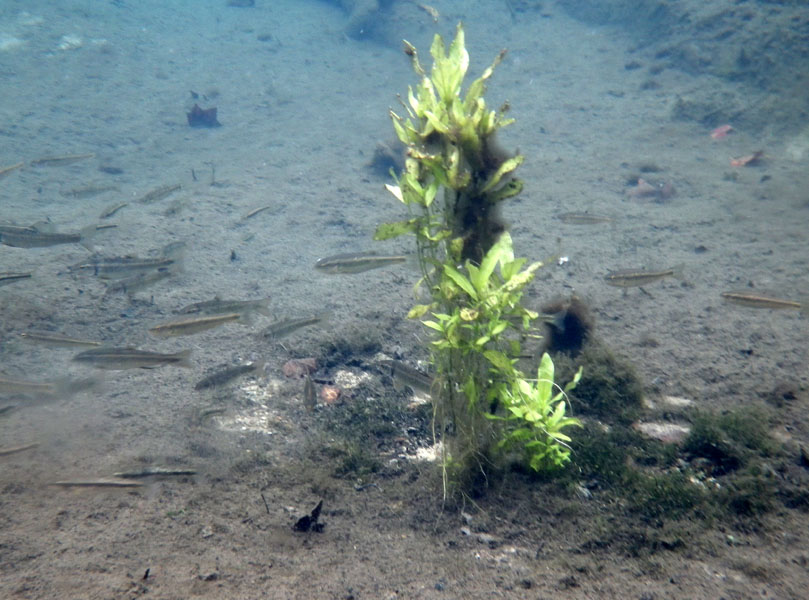
 or around the bases of some of the clumps of vegetation (here, a Ludwigia sp.). A mix of stonerollers (Campostoma oligolepis), creek chubs (Semotilus atromaculatus), and orangeside dace (Rhinichthys obtusus) are milling about in the foreground.

One notable change this fall has been an increase in filamentous algae; here it's growing on muskgrass (Chara), sticks, and exposed rock. The floating clumps at the surface are algal mats that have floated free and are decaying.


The algae can look almost otherworldly... The small fish near the surface are western mosquitofish (Gambusia affinis), which are the most abundant fish species in the spring.

A happy TNACI team at the end of a long field day.  If you'd like to see more pictures from our field work at Colvard, check out our Facebook photo album!


Sunday, October 16, 2011

Snakehead Sampling

Wow, it's been a while since we've posted.  We've got a lot to catch up on, so we'll start with a post about our adventures with one of the more famous invasive species, the northern snakehead (Channa argus).  These fish are a popular food fish in their native range of eastern Asia.  Though we hate to villify a species, these fish can seem pretty nasty outside of their home range.  Snakeheads have plenty of teeth, can breathe air through an accessory lung and persist out of water for up to four days, and are very aggressive about guarding their nests from other predators.  So understandably, a lot of people are concerned about their introduction and the impacts they might have on native fishes.

At the end of September, we dashed over to Arkansas to collect snakeheads for a few exhibits.  They've been introduced into two counties in central Arkansas, and we spent a lot of time seining muddy-bottomed agricultural ditches like these:

While the collecting was hard work (and the mosquitoes ate well!), we did manage to find a nice scaly toothy critter for our new exhibit on invasive species for the Aquarium.
It wasn't all scales, though.  We found a nice little green tree frog (Hyla cinerea) at one of our collecting sites who wasn't too unhappy to pose for photos.
Stop by the Aquarium in December to check out our new invasive species exhibit!

Friday, August 26, 2011

Guest Post: Views from our High School Volunteer

The experience I had as a volunteer with the TNACI Sturgeon Husbandry Program was, in short, phenomenal. Throughout my six weeks with TNACI my eyes were opened to countless new perspectives and insights regarding conservation, ranging from sturgeon to silt, sustainable seafood to stunned sunfish, animal care to education. The Husbandry Program is undeniably ambitious, a quality emphasized more so when one considers the extreme frailty of the young sturgeon’s fettle. Nevertheless, what struck me the most about the project was the relentless torrent of enthusiastic energy that fueled it, particularly an eagerness to engage the external community. This desire to not only better the environment, but to also teach and encourage the participation of others was trademark of all of TNACI’s projects. Whether organizing an attention-grabbing production such as the highly publicized sustainable seafood event or contemplating smaller scale outreach to children with an iconic “Sammy the Sturgeon”—my personal favorite—the Conservation Institute dedicates itself to more than “giving fish” to the community. Rather than resuscitating the marine environment for a few more years, it strives ardently to but to “teach [us all] how to fish” on our own, ballooning effectiveness and longevity through mass participation. Examine my own experience. Hardly a high school senior, not to mention completely oblivious to the mechanics of sturgeon reintroduction and marine science, I was accepted into the TNACI scene with enthusiasm and welcome. Despite my initial ignorance, I was invited to partake in a slew of incredible experiences, not only watching the young sturgeon grow and fight off an Aeromonas attack, but even being invited outside of the husbandry facility, collecting sunfish for the aquarium via an electroshocking boat.

Caroline (l) and Sarah (r) snorkeling in the Hiwassee River
It was through TNACI’s willingness to educate and share its passion for conservation that I in turn was inspired. Thanks to my exploits this summer at the expense of TNACI’s generosity, I look forward to passing on the torch, to spreading the enthusiasm and commitment to educate within my own community.

--Caroline Wiernicki, Summer Volunteer

Tuesday, August 2, 2011

Snorkeling Day

Last Friday, we all headed out for some summer snorkeling in the Hiwassee River to celebrate the last day of our high school summer volunteer, Caroline. The access point was a bit remote (lots of time on gravel roads!), but it was a pleasant day and everyone saw many beautiful native fish species, including tangerine darters (Percina aurantiaca), mirror shiners (Notropis spectrunculus), whitetail shiners (Cyprinella galactura), and logperch (Percina caprodes). Despite the isolation of the area, it was still being impacted by aquatic nuisance species. We saw two invasive species, redbreast sunfish (Lepomis auritus, discussed here), and Asian clams (Corbicula fluminea).

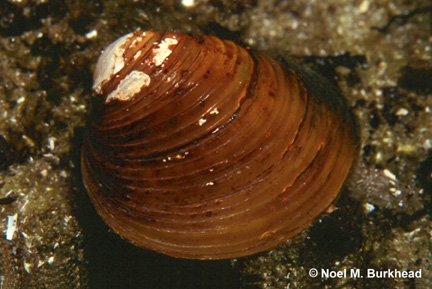
Asian clams are native to Southeast Asia and parts of Russia. They were first seen in the United States in 1938 and have spread to almost 40 states since then. They were first brought into the country by immigrants using it for food, but now the main pathways of spread are bait buckets and intentional release.

Asian Clam (Corbicula fluminea). From http://nas.er.usgs.gov/XIMAGESERVERX/2005/20051110110923.jpg

Once the clams are established in an area, they outcompete native invertebrates for habitat and food. They also spread very quickly, in part because they are hermaphroditic, possessing both male and female reproductive organs. Asian clams are capable of self fertilization, and a single clam can produce seventy thousand offspring per year. The larvae are free swimming, an advantage over the native mussels whose larvae must attach to fish to disperse. Asian clams also cause economic damage through biofouling. In a very short time, pipes can become clogged with these small clams, and they have cost the U.S. millions of dollars in pipe repair or replacement.

So we did our part for native species on Friday—we opened up a few Asian clams to feed to the tangerine darters and logperch swimming around us! It was quite the feeding frenzy.


Thursday, July 7, 2011

Red Alert

Redbreast sunfish (Lepomis auritus) and red shiners (Cyprinella lutrensis) are two common invasive species that inhabit Tennessee waters. However, they have native fishes on “red alert,” threatening them with extinction.


Redbreast sunfish are very common in Tennessee and popular with anglers. They inhabit a wide range of aquatic habitats including small creeks, large rivers, and reservoirs. They are in the same genus as other common sunfish species in the area, like the bluegill sunfish (Lepomis macrochirus), and longear sunfish (Lepomis megalotis). Despite their popularity, redbreast sunfish are are causing ecological damage.

Native to the Atlantic and Gulf slopes, they were introduced into Tennessee and other states in the 1920’s and 1930’s for sports fishing. Now they are established throughout the Tennessee River drainage. They occupy a similar ecological niche as native sunfish species, requiring the same resources and serving the same function in the ecosystem. Because of this, they compete with bluegill sunfish and longear sunfish for food and habitat. In some areas, redbreast sunfish have caused the extinction of longear sunfish becasue of resource competition.


Red ShinersRed Shiner (Cyprinella lutrensis) from http://www.bio.txstate.edu/~tbonner/txfishes/red%20shiner%20breed%20wf.jpg


Red shiners are a small minnow species native to rivers and streams in the central United States. Introductions outside the native range occurred due to home aquarium and bait bucket releases. They are native to western portions of Tennessee, but not to central or eastern Tennessee. Currently, there are no established populations outside the native range in the state, but they are established in the Upper Coosa River System in Northern Georgia and are moving quickly. They pose a serious threat to native species in the Coosa River and to the Tennessee River should they establish.


Water quality in many streams of the southeastern U.S. is severely degraded due to urbanization. Red shiners are able to thrive under in these conditions, giving them an advantage over native fishes that cannot adapt to rapid environmental changes. Red shiners also reproduce with native minnow species, resulting in a variety of hybrids. So far, nine different red shiner hybrids have been documented. One of the common combinations is a red shiner-blacktail shiner (Cyprinella venusta) hybrid. Hybridization reduces genetic diversity and fitness of the native species. In some areas, hybridization happens so quickly, that the native parent species goes extinct.

Thursday, June 30, 2011

Water Weeds

Aquatic invasive animals are not the only species that cause problems in Tennessee and the southeastern United Sates. Invasive plants can cause just as many problems. Aquatic plants are introduced outside their native range by being transported on boat propellers and boat trailers or from home aquariums.

There are many ecological and economic problems associated with invasive plants. An overgrowth of an invasive plant can block the sun from native species, causing them to die and reducing plant biodiversity. The corresponding increase in dead plant material at the bottom of a lake or pond can result in the loss of all oxygen in the water as bacteria break down the dead plants. This process is called eutrophication. Invasive plant species can also crowd and degrade bottom habitat for fish and invertebrates.


Many invasive plants, like Hydrilla (Hydrilla verticillata), can form large mats. These mats often jam propellers and ruin boat engines. The mat may grow so thick that the water becomes inaccessible to boaters and swimmers. Plants can also foul anglers’ equipment. Some aquatic invasive plants are vectors for diseases that impact native wildlife.


To prevent the spread of invasive plants, check, clean, and dry. Check all parts of a boat and other equipment for plant fragments. Some of these species, like Eurasian watermilfoil (Myriophyllum spicatum) can reproduce by fragmentation. One small piece of the plant will grow into a full plant. Properly clean all gear before transporting either home or to another body of water. Let all equipment dry for 48 hours before using it another area.


Read the following stories from Chattanooga Times Free Press to learn about what is being done to control populations of invasive plants in local waters.
http://www.timesfreepress.com/news/2011/may/31/waging-war-water-weeds/
http://www.timesfreepress.com/news/2011/jun/27/whacking-water-weeds/