Friday, August 26, 2011

Guest Post: Views from our High School Volunteer

The experience I had as a volunteer with the TNACI Sturgeon Husbandry Program was, in short, phenomenal. Throughout my six weeks with TNACI my eyes were opened to countless new perspectives and insights regarding conservation, ranging from sturgeon to silt, sustainable seafood to stunned sunfish, animal care to education. The Husbandry Program is undeniably ambitious, a quality emphasized more so when one considers the extreme frailty of the young sturgeon’s fettle. Nevertheless, what struck me the most about the project was the relentless torrent of enthusiastic energy that fueled it, particularly an eagerness to engage the external community. This desire to not only better the environment, but to also teach and encourage the participation of others was trademark of all of TNACI’s projects. Whether organizing an attention-grabbing production such as the highly publicized sustainable seafood event or contemplating smaller scale outreach to children with an iconic “Sammy the Sturgeon”—my personal favorite—the Conservation Institute dedicates itself to more than “giving fish” to the community. Rather than resuscitating the marine environment for a few more years, it strives ardently to but to “teach [us all] how to fish” on our own, ballooning effectiveness and longevity through mass participation. Examine my own experience. Hardly a high school senior, not to mention completely oblivious to the mechanics of sturgeon reintroduction and marine science, I was accepted into the TNACI scene with enthusiasm and welcome. Despite my initial ignorance, I was invited to partake in a slew of incredible experiences, not only watching the young sturgeon grow and fight off an Aeromonas attack, but even being invited outside of the husbandry facility, collecting sunfish for the aquarium via an electroshocking boat.

Caroline (l) and Sarah (r) snorkeling in the Hiwassee River
It was through TNACI’s willingness to educate and share its passion for conservation that I in turn was inspired. Thanks to my exploits this summer at the expense of TNACI’s generosity, I look forward to passing on the torch, to spreading the enthusiasm and commitment to educate within my own community.

--Caroline Wiernicki, Summer Volunteer

Tuesday, August 2, 2011

Snorkeling Day

Last Friday, we all headed out for some summer snorkeling in the Hiwassee River to celebrate the last day of our high school summer volunteer, Caroline. The access point was a bit remote (lots of time on gravel roads!), but it was a pleasant day and everyone saw many beautiful native fish species, including tangerine darters (Percina aurantiaca), mirror shiners (Notropis spectrunculus), whitetail shiners (Cyprinella galactura), and logperch (Percina caprodes). Despite the isolation of the area, it was still being impacted by aquatic nuisance species. We saw two invasive species, redbreast sunfish (Lepomis auritus, discussed here), and Asian clams (Corbicula fluminea).

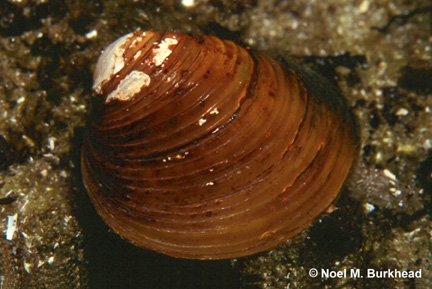
Asian clams are native to Southeast Asia and parts of Russia. They were first seen in the United States in 1938 and have spread to almost 40 states since then. They were first brought into the country by immigrants using it for food, but now the main pathways of spread are bait buckets and intentional release.

Asian Clam (Corbicula fluminea). From http://nas.er.usgs.gov/XIMAGESERVERX/2005/20051110110923.jpg

Once the clams are established in an area, they outcompete native invertebrates for habitat and food. They also spread very quickly, in part because they are hermaphroditic, possessing both male and female reproductive organs. Asian clams are capable of self fertilization, and a single clam can produce seventy thousand offspring per year. The larvae are free swimming, an advantage over the native mussels whose larvae must attach to fish to disperse. Asian clams also cause economic damage through biofouling. In a very short time, pipes can become clogged with these small clams, and they have cost the U.S. millions of dollars in pipe repair or replacement.

So we did our part for native species on Friday—we opened up a few Asian clams to feed to the tangerine darters and logperch swimming around us! It was quite the feeding frenzy.


Thursday, July 7, 2011

Red Alert

Redbreast sunfish (Lepomis auritus) and red shiners (Cyprinella lutrensis) are two common invasive species that inhabit Tennessee waters. However, they have native fishes on “red alert,” threatening them with extinction.


Redbreast sunfish are very common in Tennessee and popular with anglers. They inhabit a wide range of aquatic habitats including small creeks, large rivers, and reservoirs. They are in the same genus as other common sunfish species in the area, like the bluegill sunfish (Lepomis macrochirus), and longear sunfish (Lepomis megalotis). Despite their popularity, redbreast sunfish are are causing ecological damage.

Native to the Atlantic and Gulf slopes, they were introduced into Tennessee and other states in the 1920’s and 1930’s for sports fishing. Now they are established throughout the Tennessee River drainage. They occupy a similar ecological niche as native sunfish species, requiring the same resources and serving the same function in the ecosystem. Because of this, they compete with bluegill sunfish and longear sunfish for food and habitat. In some areas, redbreast sunfish have caused the extinction of longear sunfish becasue of resource competition.


Red ShinersRed Shiner (Cyprinella lutrensis) from http://www.bio.txstate.edu/~tbonner/txfishes/red%20shiner%20breed%20wf.jpg


Red shiners are a small minnow species native to rivers and streams in the central United States. Introductions outside the native range occurred due to home aquarium and bait bucket releases. They are native to western portions of Tennessee, but not to central or eastern Tennessee. Currently, there are no established populations outside the native range in the state, but they are established in the Upper Coosa River System in Northern Georgia and are moving quickly. They pose a serious threat to native species in the Coosa River and to the Tennessee River should they establish.


Water quality in many streams of the southeastern U.S. is severely degraded due to urbanization. Red shiners are able to thrive under in these conditions, giving them an advantage over native fishes that cannot adapt to rapid environmental changes. Red shiners also reproduce with native minnow species, resulting in a variety of hybrids. So far, nine different red shiner hybrids have been documented. One of the common combinations is a red shiner-blacktail shiner (Cyprinella venusta) hybrid. Hybridization reduces genetic diversity and fitness of the native species. In some areas, hybridization happens so quickly, that the native parent species goes extinct.

Thursday, June 30, 2011

Water Weeds

Aquatic invasive animals are not the only species that cause problems in Tennessee and the southeastern United Sates. Invasive plants can cause just as many problems. Aquatic plants are introduced outside their native range by being transported on boat propellers and boat trailers or from home aquariums.

There are many ecological and economic problems associated with invasive plants. An overgrowth of an invasive plant can block the sun from native species, causing them to die and reducing plant biodiversity. The corresponding increase in dead plant material at the bottom of a lake or pond can result in the loss of all oxygen in the water as bacteria break down the dead plants. This process is called eutrophication. Invasive plant species can also crowd and degrade bottom habitat for fish and invertebrates.


Many invasive plants, like Hydrilla (Hydrilla verticillata), can form large mats. These mats often jam propellers and ruin boat engines. The mat may grow so thick that the water becomes inaccessible to boaters and swimmers. Plants can also foul anglers’ equipment. Some aquatic invasive plants are vectors for diseases that impact native wildlife.


To prevent the spread of invasive plants, check, clean, and dry. Check all parts of a boat and other equipment for plant fragments. Some of these species, like Eurasian watermilfoil (Myriophyllum spicatum) can reproduce by fragmentation. One small piece of the plant will grow into a full plant. Properly clean all gear before transporting either home or to another body of water. Let all equipment dry for 48 hours before using it another area.


Read the following stories from Chattanooga Times Free Press to learn about what is being done to control populations of invasive plants in local waters.
http://www.timesfreepress.com/news/2011/may/31/waging-war-water-weeds/
http://www.timesfreepress.com/news/2011/jun/27/whacking-water-weeds/

Monday, June 27, 2011

Guest Post: First Time River Snorkeling

As an intern at TNACI, I was recently given the opportunity to perform fieldwork with some of the aquarists from the Tennessee Aquarium. We traveled to the Tellico Plains area. Here, we focused on the Little Tennessee River and the Tellico River. Our goal was to collect fish for one of the River Journey exhibits.

The first place we stopped was the Little T River. Here, we used seine nets to catch shiners and darters. We mostly caught Saffron Shiners and Warpaint Shiners as well as some Rosyside Dace. There were also numerous sightings of Rainbow Trout of all sizes, suggesting they have moved into the area and are breeding.

Saffron Shiner.  Photo by Noel Burkhead
In order to catch other fish for the exhibit, we had to snorkel in the river with small hand nets. This seemed like a difficult and odd task at first, but snorkeling in shallow rivers is very exhilarating! Using this technique we were able to catch individuals from several darter species, including eight Tangerine Darters in the Tellico River! 

Tangerine Darter.  Photo by Conservation Fisheries, Inc.
My favorite part of the experience was discovering the diverse microhabitats of these river systems and which fish tend to be found where. I never knew there were so many colors to see! If given the chance, everybody should go snorkeling in a river, it is just as amazing as exploring a coral reef in the ocean.

--Sarah Candler, TNACI Intern

Thursday, June 23, 2011

When Bait Takes Over

The rivers of Tennessee and the southeastern United States are some of the most diverse ecosystems in the world, especially for invertebrates like mussels and crayfish. Crayfish are especially diverse in Tennessee, with at least 70 species inhabiting our waters. Many crayfish species are specially adapted to their environments, and many only inhabit one or two watersheds. The Nashville crayfish is found only in the Mills Creek basin in central Tennessee, while the Chickamauga crayfish is found only in the South Chickamauga Creek basin, which spans four counties in Georgia and Tennessee. These species are of greater conservation concern due to their small ranges or specialized habitat. Like many other native aquatic animals in the southeastern U.S., they are also under threat due to the introduction of invasive crayfish species.

Crayfish, also called crawdads, crawfish, or mudbugs, are commonly used as bait by commercial and recreational fishermen. They are either purchased from bait stores, or caught from the wild by anglers. Often at the end of the day, the bait is released where used, without regard to its original source. Virtually every invasive crayfish species in Tennessee has been introduced by bait bucket releases. Once introduced, non-native crayfish negatively impact ecosystems and can cause economic losses through damage to riverbanks, dams and dikes. Many invasive crayfish species directly prey on native snails, fish, and crayfish, while others eat or destroy aquatic vegetation that provides habitat and food for native fish. Many of the invasive species are very aggressive and outcompete native crayfish species for burrows or cover.


The Tennessee Wildlife Resources Agency lists six non-native crayfish species as warranting particular concern: bigclaw crayfish, Cumberland crayfish, red swamp crayfish, rusty crayfish, virile crayfish, and White River crayfish. Because these species are generalists compared to many of the native crayfish species, they can spread rapidly through a watershed if introduced. Rusty crayfish and virile crayfish have even been documented hybridizing with native species.

The biggest step you can take in preventing the introduction of invasive crayfish is to use them for bait only from the stream that you are fishing, to take only what you need, or to release bait crayfish from the same stream from which you caught them.

Thursday, June 16, 2011

River Invaders

The name Asian carp is used to describe four different species of carp: grass carp, bighead carp, silver carp, and black carp. These fish were introduced in the United States in the 1970s and since that time have spread rapidly. At least one species of Asian carp is found in every state except Alaska, Maine, Montana, Rhode Island, and Vermont. They pose a major ecological threat to native aquatic wildlife and river ecosystems, as well as a significant economic threat to commercial fisheries.

All Asian carp species are native to large rivers in eastern Asia and were introduced in the U.S. to “improve” water quality. Some species, such as the grass carp, were introduced to control nuisance plant species because they eat algae and other aquatic plants. Other species, such as the black carp, eat mussels and snails and were introduced to control disease carrying invertebrates in aquaculture ponds.


From aquaculture, Asian Carp were introduced into American rivers by illegal and intentional release, or by accidental escapes from river flood waters reaching aquaculture ponds. Once in the wild, they pose several threats to the ecosystem. Grass carp consume enormous amounts of plants. Their voracious appetite robs native fish and invertebrates of their food source. Large quantities of carp waste degrade water quality.

The two species threatening the Great Lakes are the silver and bighead carp. Millions of dollars have been spent on electric barriers, cameras, and other monitoring equipment attempting to protect the lakes. Asian carp have already caused extensive environmental and economic damage in the Mississippi and Missouri River basins. Many people have had to abandon their fishing grounds because of the presence of carp. This threatens a 7 billion dollar per year commercial and recreational fishery in the Great Lakes. Silver carp can also harm humans. When startled by boat motors, the fish (which can weigh up to 60 lbs!) leap out of the water, causing potential injury or fatality to people.


There is now concern that the extent of Asian carp’s range has increased. The flooding of the Mississippi and Missouri rivers this year may have transported some of these fish into lakes and tributaries where there are no established carp populations.